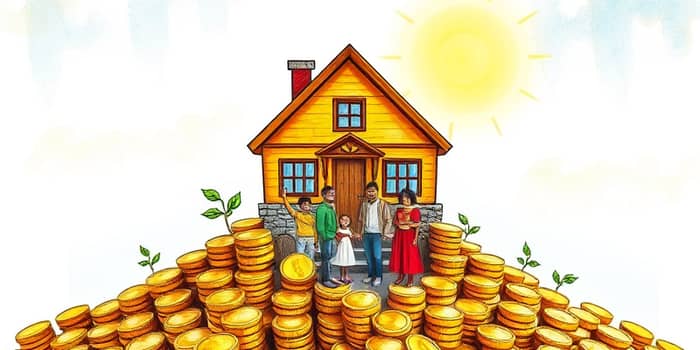
Real estate has long been more than a shelter—it is a cornerstone of financial security, personal achievement, and community prosperity. In the United States, homeownership transcends mere property rights, evolving into a powerful engine for wealth creation and intergenerational stability.
From coast to coast, families build equity, pass down assets, and leverage their homes as a catalyst for lifelong opportunity. This article explores how homeownership underpins national economic activity, illuminates pathways to generational wealth, and highlights the challenges that shape today’s market.
The Magnitude of the U.S. Housing Market
With a total valuation of $49.7 trillion in 2024, the U.S. housing market represents nearly one-fifth of the nation’s economic activity. Homeowners collectively hold about $35 trillion in equity, reflecting decades of price appreciation and mortgage paydown.
- Market value: $49.7 trillion in 2024
- Home equity held: $35 trillion (Q4 2024)
- Economic impact: 19% of U.S. GDP in 2022
These figures underscore real estate’s unrivaled role in driving consumption, investment, and fiscal stability. Even as the broader economy navigates slowdowns and inflationary pressures, housing remains a bedrock of financial resilience.
The Mechanics of Wealth-Building Through Homeownership
At its core, buying a home combines forced savings with long-term appreciation. Each mortgage payment reduces principal and cultivates equity—effectively a forced savings account through equity. Over time, rising home values further amplify net worth.
Since 2019, existing home prices have climbed by 60%, translating into an average homeowner gain of $190,000 over the last decade. By early 2025, the typical homeowner held unprecedented home price appreciation since 2019, with median existing home prices at $408,000 and new builds averaging $411,000.
As a result, the typical homeowner’s net worth is about 40 times that of a renter. The combination of mortgage paydown and market gains creates a long-term stable wealth-building vehicle that few other assets can match.
Disparities and Demographic Insights
Not all homeowners experience equal benefits. Wealth gains vary by income and race, exposing systemic inequities in access and outcomes. From 2012 to 2022, low-income homeowners saw appreciation of $98,900, while middle- and upper-income households gained $122,100 and $150,800, respectively.
Black homeowners realized a median wealth increase of $115,000—lower than other racial or ethnic groups. This gap stems from historical barriers, differential down-payment support, and limited access to intergenerational assistance.
Homeownership rates also diverge by generation and background. While Baby Boomers maintain high ownership, younger adults face affordability hurdles that threaten intergenerational wealth transfer and stability.
Current Market Trends and Challenges
After years of double-digit gains, 2025 has ushered in a period of moderated appreciation. Home prices increased just 3.9% year-over-year in early 2025, lagging behind the 2.7% consumer price index rise. The Case-Shiller 20-city index even recorded its fourth straight monthly drop in June.
- Supply shortages persist: resale inventory remains 20-30% below historical lows.
- New construction: highest unsold new-home stock since 2007.
- Mortgage rates: over 80% of borrowers locked into below-market rates.
Affordability is strained, especially in high-cost regions. In California, monthly payments for mid-tier homes have risen by nearly $2,400 since 2020. Prospective buyers face climbing down-payment requirements and stiff competition for limited listings.
Supply, Demand, and Policy Implications
To meet demographic shifts and household formation trends, analysts estimate a need for 18 million new housing units by 2035. Construction costs—inflated by tariffs, labor shortages, and supply chain disruptions—undermine efforts to close the gap.
Policy debates around Fannie Mae and Freddie Mac privatization further cloud the outlook. Any move that raises financing costs could curtail demand, reduce mobility, and deepen regional disparities.
The Road Ahead for Homeownership
Experts predict a return to fundamentals, with housing growth aligning closer to inflation—offering stable, moderate returns rather than pandemic-era windfalls. While this shift may temper exuberant speculation, it also emphasizes the importance of timing, location, and financing in wealth-building strategies.
Regional cooling is underway in former hot spots like the Sun Belt, as buyers weigh sustainable employment, local amenities, and affordability. Yet, 80% of Americans across generations still regard homeownership as essential for long-term prosperity.
In the face of challenges, the housing market remains a powerful platform for equity accumulation, community development, and family legacy. By understanding market dynamics, addressing accessibility gaps, and fostering inclusive policies, we can ensure that homeownership continues to serve as a foundation of wealth for all.
References
- https://www.jpmorgan.com/insights/global-research/real-estate/us-housing-market-outlook
- https://www.nar.realtor/research-and-statistics/research-reports/wealth-gains-by-income-and-racial-ethnic-group
- https://fortune.com/2025/08/30/housing-market-wealth-building-home-prices-demand-inflation-trump-tariffs/
- https://www.bankrate.com/home-equity/home-equity-and-building-generational-wealth/
- https://www.morganstanley.com/insights/articles/housing-market-outlook-2025-2035-mortgage-rates-home-prices
- https://www.urban.org/urban-wire/wealth-gap-between-homeowners-and-renters-has-reached-historic-high
- https://www.ipx1031.com/investing-statistics-by-generation/
- https://privatebank.jpmorgan.com/apac/en/insights/markets-and-investing/tmt/a-shortage-of-supply-the-housing-market-explained
- https://www.chase.com/personal/investments/learning-and-insights/article/tmt-october-seventeen-twenty-five
- https://www.pwc.com/us/en/industries/financial-services/asset-wealth-management/real-estate/emerging-trends-in-real-estate-pwc-uli.html
- https://lao.ca.gov/LAOEconTax/Article/Detail/793
- https://www.nar.realtor/research-and-statistics